
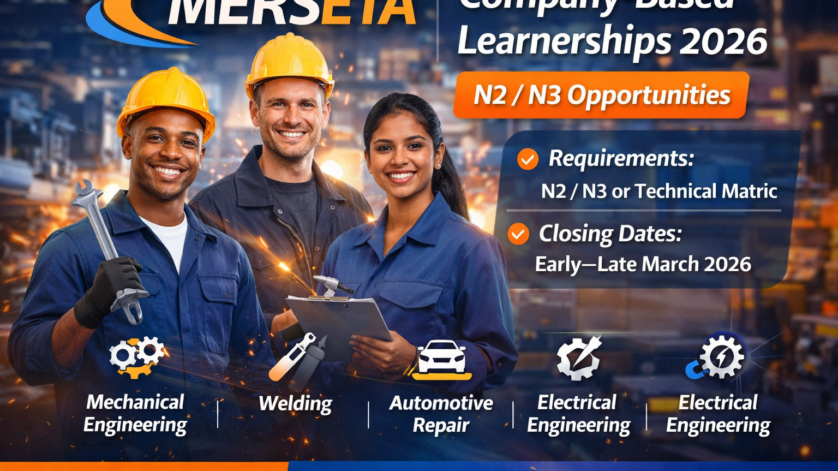
The Manufacturing, Engineering and Related Services SETA (MERSETA) continues to play a vital role in developing technical skills across South Africa by partnering with private companies in the manufacturing and engineering sectors. For 2026, MERSETA company-based learnerships offer excellent opportunities for candidates with N2 or N3 qualifications to gain practical workplace experience while earning a stipend.
These learnerships are ideal for young people who want to build careers in engineering, automotive, and industrial trades. If you are serious about becoming an artisan or technician, this is one of the best entry pathways into the private sector.
📌 Overview of MERSETA Learnerships
MERSETA does not always recruit directly. Instead, it partners with private companies such as manufacturing plants, engineering firms, and automotive workshops. These companies host learners and provide hands-on training, while MERSETA supports the programme structure and funding.
🎓 Minimum Qualifications Required
To qualify for MERSETA company-based learnerships, you must meet the following:
- N2 or N3 Certificate in a relevant field
- OR Technical Matric (with Mathematics & Science)
- South African citizen
- Age between 18 – 35 years
- Basic understanding of engineering concepts
- Willingness to work in industrial environments
💡 Having N3 gives you a stronger advantage, especially for artisan trades like fitting or electrical work.
🔧 Fields Offered in 2026
MERSETA learnerships cover a wide range of high-demand technical fields, including:
1. Mechanical Engineering
- Fitter & Turner
- Millwright
- Diesel Mechanic
- Maintenance Technician
👉 Focuses on machinery, production systems, and plant maintenance.
2. Welding & Metal Fabrication
- Boilermaking
- Welding (MIG, TIG, Arc)
- Structural fabrication
👉 Ideal for candidates who enjoy hands-on metal work and construction environments.
3. Automotive Repair & Maintenance
- Motor Mechanic
- Auto Electrical
- Panel Beating
👉 Popular in private automotive companies and dealerships.
4. Electrical Engineering (in some companies)
- Electrician
- Industrial Electrical Technician
👉 Includes installation, fault finding, and maintenance of electrical systems.
🏭 Companies That Typically Partner with MERSETA
Although openings change frequently, MERSETA partners with companies such as:
- Automotive manufacturers
- Engineering workshops
- Steel and fabrication companies
- Industrial production plants
These companies provide real workplace exposure, making it easier to secure permanent employment after completing the learnership.
📥 How to Apply
Since MERSETA works through partner companies, applications are usually submitted in two ways:
✔ Option 1: Apply Through Company Career Pages
Search for:
- “MERSETA Learnership 2026”
- “Engineering Learnership N2/N3”
✔ Option 2: Send Applications via Email
You can send your CV directly to MERSETA or partner companies:
📧 General Application Email:
info@merseta.org.za
📞 Telephone Number:
+27 (0) 11 484 9310
📄 Documents to include:
- Updated CV
- Certified ID copy
- N2 / N3 Certificate
- Proof of residence
💡 Tip: Use a subject line like:
“Application: MERSETA Learnership 2026 – N2 Mechanical”
🚀 Why Choose MERSETA Learnerships?
MERSETA programmes are highly respected because they:
✔ Provide practical workplace experience
✔ Offer a monthly stipend
✔ Improve your chances of becoming a qualified artisan
✔ Open doors to permanent employment in private companies
✔ Align with South Africa’s skills demand in engineering
⚠️ Important Application Tips
- Apply early (many positions close quickly in March)
- Prepare a strong CV highlighting your technical subjects
- Be ready for aptitude tests or interviews
- Apply to multiple companies to increase your chances
📍 Sector: Private Manufacturing & Engineering
📅 Closing Dates: Early – Late March 2026 (varies by company)
💰 Stipend: Typically R3 500 – R6 500 per month
📜 Duration: 12–24 months
📊 Final Thoughts
MERSETA company-based learnerships for 2026 are a powerful opportunity for N2 and N3 graduates to enter the engineering and manufacturing industries. With strong partnerships in the private sector, these programmes provide real-world experience that employers value.
If you’re serious about building a career as an artisan, technician, or mechanic, this is your chance to gain skills, earn income, and secure your future.